Tuesday, April 29, 2014

Let's Lobby!

In the energy discourse it is almost impossible to obtain "fair and balanced" information. It seems everybody out there is lobbying for something, consequently "their" energy is perfect, emits zero pollutants, and creates loads of jobs while the "other" energy is the devil. As easy as that. However, real life, as always, is not black or white, we really don't have out there a picture-perfect solution for a nonexistent binary world.

Can we begin to talk, listen and respect each other instead of just pointing fingers (and even hurling insults)?

Lobbyists are PAID to blindly defend a position and thus they should probably not even be invited to the conversation because as Upton Sinclair stated:

"It is difficult to get a man to understand something, when his salary depends upon his not understanding it."

On the other hand, the REST of us should employ very healthy doses of skepticism when listening to them. Let's label them as what they really are: paid advertisers.

So, let's stop flying and make a soft landing. Here are some basic things we all need to understand:

  • No energy is clean. Period. End of story. Elvis has left the (pick one): solar panel / wind turbine / nuclear reactor / dam. 
  • Thus, no energy is zero emissions (once you consider the lifetime emissions of the respective technology). 
  • The most we can say is that something is cleaner or lower carbon than something else. 
  • When discussing subsidies, let's not say x receives so many dollars and y receives only this other amount. Things have to be stated in subsidies per energy produced to have a reference point.
Now, let's briefly scan the main energy sources and focus only on their most important characteristics. Let's not be distracted with side issues (like if wind turbines kill more birds than skyscrapers or not). 

Fossil Fuels:
  • They are high carbon.
  • In particular coal, causes a substantial number of casualties during its extraction.
  • In addition to carbon, they liberate other important pollutants to the environment.
  • Not considering externalities, they are the cheapest energy sources we have on a global scale.
  • Our current infrastructure is built around them.
  • They are convenient, reliable, flexible, high density energy sources. 
  • Entire countries depend on the revenue they produce not to mention many millions of jobs all over the world.
  • Carbon Capture and Storage (CCS) has not been widely deployed. 
  • According to the EIA, IEA, they will continue to dominate the energy market for decades to come. 
Now, let's take a look at the low carbon energy sources.

Sun and Wind:
  • They are intermittent and unreliable and no amount of spin can change this. The low costs quoted for these technologies consider them piggy-backing on the conventional grid. If they were required to pay for the full effects of their intermittency / unreliability their costs would skyrocket.
  • As an individual component, they seem to be low carbon, but once the system is considered (RE + FF backup), the emissions go up enough to even question if they are truly low carbon solutions.
  • Storage or other means to compensate for the above have not been widely deployed.
Nuclear: 
  • It is reliable, dense, safe, scaleable and produces little (although dangerous) waste.
  • Is currently fighting an uphill battle against irrational fears planted by lobbyists (see above).
  • Globally, it currently holds the highest market penetration in the production of low carbon electricity.
Hydro:
  • It has served us well for many, many decades.
  • As a percentage of our total energy consumption, it probably has reached its peak. 
Conclusion: the move away from fossil fuels will be gradual, will take many decades and they will not be replaced by the perfect energy source (which doesn't exist). We need to make hard sensible decisions minimizing the effects of the "paid advertisers."

Feel free to add to the conversation on Twitter.

Thank you.


Labels: , , , , , , , ,

Thursday, April 24, 2014

Going Nuclear

This is a simplified exercise to visualize what would be required to convert 50% of the world's electricity to nuclear, the premier low carbon source.


According to the EIA (Energy Information Administration) latest report, the global generation of electricity in 2010 was 20.2 trillion kWh, and they project that by 2040 total global generation will reach 39.0 trillion kWh.

So, if we decide to generate 50% of our electrical energy with nuclear (at, say, an average 80% capacity factor), we would require this number of 1 GWe reactors:

     50% of 39.0 trillion kWh is 19.5.

Let's convert trillion kWh to GWh by multiplying it by one million:

     We now have 19,500,000 GWh.

A 1 GWe nuclear plant at 80% capacity factor (CF) produces, on an annual basis:

     1GWe x 0.80CF x 24 hrs x 365 days = 7,008 GWh.

Thus, we would need this number of reactors by 2040:

     19,500,000 / 7,008 = 2,783.

Simplifying thing a little, let's consider that half of the current nuclear plants will still be in operation by 2040. According to the EIA, nuclear supplied 2.6 trillion kWh in 2010. This would correspond to the equivalent of 371 1 GWe reactors at 80% CF. If half of these are in operation by 2040, we can subtract 186 from the number calculated above, thus we get:

     2,783 - 186 = 2,597 new nuclear reactors.

If we have 30 years to build them, it would require the commissioning of:

     2,597 / 30 = 87 nuclear reactors EVERY year for 30 CONSECUTIVE years.

And again, let's remember that the above effort would only yield 50% of our global electricity and around 25% of our total energy consumption by 2040.

At the end of the day we have to differentiate what is possible, from what is probable.

The probability of this nuclear build up taking place by 2040 is, in my humble opinion, less than zero.

Feel free to add to the conversation.

Thank you.

EIA electricity projections from their latest report:


Notes:
1. By 2040, only ~50% of our energy consumption will be electricity.
2. There is no such thing as a global grid, so the real life implementation would be more complicated than pictured above.
3. Sure, many questions need to be answered, starting with determining if we even have the manufacturing capacity required to make such a ramp up.
4. Nuclear has a serious advantage over RE (sun and wind): it is baseload, reliable power.
5. Of the renewable power in 2040, fully 65% is estimated to be hydro.
6. Yes, there are reactors bigger and smaller than 1 GWe, we are considering all of them at 1 GWe to simplify.

Labels: , , , , , ,

Monday, April 14, 2014

Not Because They Are Easy, but Because They Are Hard

Drastically reducing our fossil fuels (FF) use without destroying the world economy and shoving most of us into a life of utter poverty is probably THE most difficult challenge humanity has ever faced.

Those that say this transition will be easy, are making a disservice to humanity. It WON'T be easy. Period.

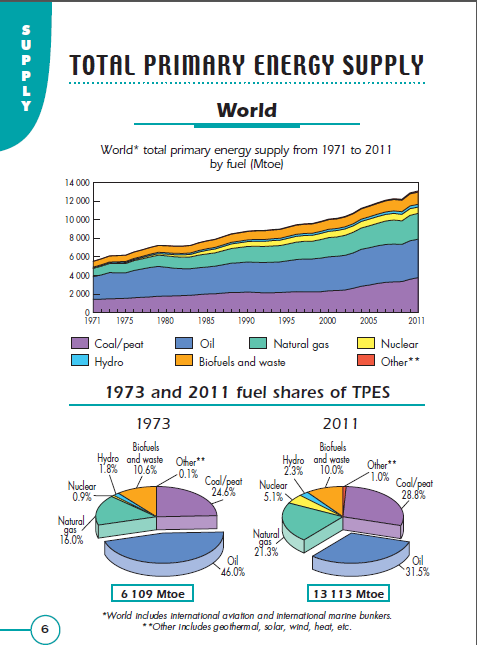
Today, ~82% of our global total primary energy supply is delivered by fossil fuels. Consequently, the global infrastructure is built around them:
   1. Motor vehicles.
   2. Fueling stations.
   3. Air travel.
   4. Factories.
   5. Power plants.
   6. Pipelines.
   8. Maritime transportation
   9. Building space heating / water heaters
   10. What have you...

Some people believe renewable energy (mainly sun and wind) will "catch fire" just like the Internet and mobile phones did some years ago, but this optimism is misplaced.

Both the Internet, as well as mobile phones gave us the opportunity to do things we could never have done before, on the other hand, a replacement of FF by RE would not provide value to the final consumer, if at all, RE would be more expensive and less flexible. Besides RE, since it is not constant, requires FF most of the time to prop them up when the sun is not shining or the wind is not blowing*.

The annual capacity factor for solar PV worldwide today is ~15%, which (simplifying) means that 85% of the time something else has to produce the electricity, and that "something" is usually a fossil fuel plant.

We have also been somewhat deceived by "Moore's Law" on how fast technological improvements can take place. Integrated circuits (ICs) today have more than one hundred million more transistors per unit area than those manufactured in the 1960's. However, ICs handle information, not loads of power, so we are talking about very different things. The advances in power production and efficiency move at a snail's pace. Say, if the energy efficiency conversion of high volume solar PV is today ~14% (in other words, the percentage of the sunlight striking the panel that is actually converted to electricity), when will it reach 28%? The answer is probably never.

So, what we are currently asking of humanity is to spend many trillions of dollars to essentially end worse off than today (sure, if everything turns out right, with a lower carbon global economy). However, for the final user low carbon electricity "tastes" the same as FF electricity but is more expensive. We also need to understand that electricity is only a fraction of our total energy consumption and the energy used in transportation and industrial processes is more difficult to replace with low carbon alternatives.

So, bottom line, is the transition possible?

The answer is yes, but it will require sacrifice, more sacrifice and yet more sacrifice.  It would require a massive nuclear build up equivalent to what France already did, but in most of the other countries in the world.

We should, however, differentiate what is possible from what is probable and so far there is nothing in the pipeline, so to speak, that will reduce our absolute use of fossil fuels.

2013 was the all time record for emissions. What will be the results in 2014? In 2015?

The first step to start solving our emissions problem is to confront the brutal truth: whatever we have been doing is NOT working. Our emissions not only are not dropping, they are INCREASING.

Let's stay tuned.


* Some RE lobbyists state that RE is has already achieved grid parity. This is not accurate. Here is why:
http://gnwr1.blogspot.mx/2013/06/grid-parity.html


Labels: , , , , , , , , ,