Thursday, October 16, 2014

Barking at the Wrong Tree?

Even though the science might (or might not) be settled, the climate discourse is still heated between those that sustain that carbon dioxide emissions are increasing the global temperature of the Earth and those that do not see it as a menace.

However, I believe this discussion is misguided and thus that we are barking at the wrong tree.

If the first camp is correct, then we need to drastically reduce our fossil fuel consumption. To be able to do this without destroying the world's economy (and thus severely curtailing the possibilities of reducing poverty and even shoving many / most of us toward that same poverty) would require a massive substitution of fossil fuels by other, lower carbon energy sources.

If the second camp is correct, the so called "deniers" then we still all probably agree that fossil fuels will not forever be cheap and abundant.

Consequently, it seems to me, both groups should agree that the (eventual) replacement of fossil fuels should be a top priority.

If we look around today, we see lots of PR from the renewable, efficiency and even the nuclear camps, but where the rubber meets the road, (in other words, massive alternative energy production ramp-up) we don't see anything worth noting.

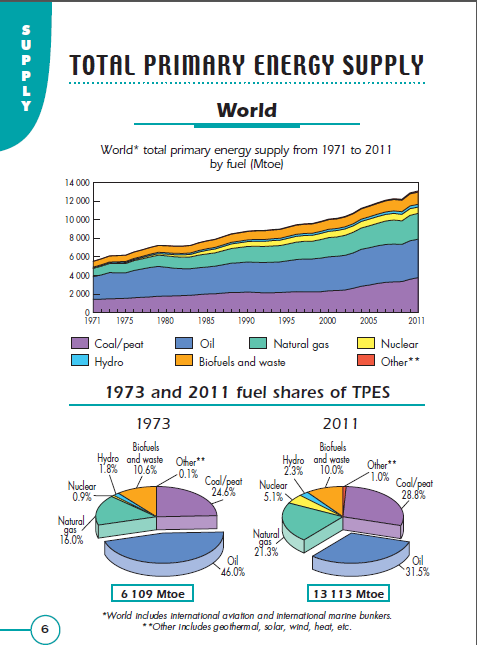
The Energy Information Administration estimates that by the year 2040, close to 80% of our primary energy will still come from fossil fuels, however, since consumption is projected to increase in absolute terms that means more CO2 emissions than today.*


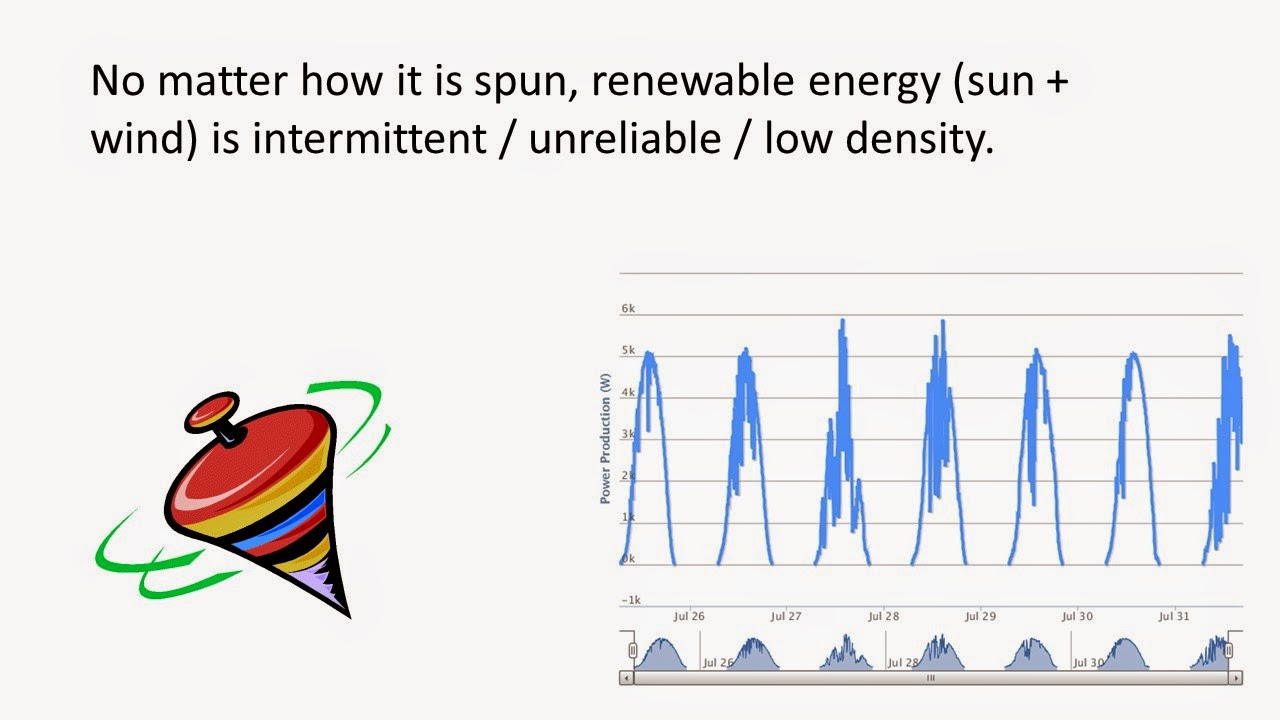
Yes, renewables (solar and wind) will survive and maybe even thrive in the coming decades but there is no way they will dominate the global energy market. Why? Because they are diffuse (in other words, weak), intermittent and unreliable. Renewables are in a sense a road to the past. Centuries ago, practically 100% of our energy was renewable but our civilization moved forward with denser and more reliable energy.

Current nuclear is not that much better. Yes, it is low carbon, yes it is orders of magnitude denser than renewables (and even than fossil fuels) but it is still too expensive and hard to scale up rapidly.

In his book Zero to One, Peter Thiel states that "only when your product is 10X better can you offer the customer transparent superiority." Well, that is certainly not yet the case respecting our current alternatives to fossil fuels.

The solution to our energy quandary has to be technology. We won't advance toward the future by walking backwards.

New nuclear (fission) designs in the drawing board seem great on paper, but to prove their concepts we would need massive implementation in the real world. This is not happening. At least not yet.

Even though it might not feel like it, our civilization has been upgrading its energy sources to better ones:

Coal is better than wood, wind and water.
Oil is better than coal.
Natural gas is better than oil.
Nuclear is better than natural gas.

Sure, the above statements are arguable, but the point is we have been moving to denser more reliable energy that is actually cleaner. (Without coal, we would probably had destroyed all our forests to use them as fuel).

So, bottom line, our civilization has been moving forward and there is no way back (at least not if we plan to support +7 billion persons).

Renewables are in a sense a return to the past. New nuclear (fission and fusion) can be a step forward, maybe even a giant step forward.

How much time do we have to replace, say, 50% of fossil fuels with nuclear? That depends on when fossil fuels will become painfully expensive / scarce.

Try as we might, this transition will probably not be fast. It may take 100, 150 years, or more, but as JFK used to say: let us begin!

Feel free to add to the conversation in Tweeter: @luisbaram

*http://www.eia.gov/forecasts/ieo/?src=home-b2


Labels: , , , , , , ,

Tuesday, September 30, 2014

Ten Times Better


In his book, Zero to One, Peter Thiel states that "only when your product is 10X better can you offer the customer transparent superiority."

In the global warming discourse, it is often stated that fossil fuels should be replaced by renewable (solar, wind, geothermal) energy sources.

However the first question we should ask is if in fact renewables are ten times better than what they are supposed to be replacing.

Well, in reality renewables not only are not ten times better than fossil fuels, they are not even plain better. What's more, in most of the important attributes of an energy source, renewables are considerably worse than fossil fuels.

So maybe this is the reason renewables are barely represented in our civilization's total energy consumption.* And this is in spite of them being the recipients of considerable subsidies per unit of energy produced.


In his book The End of Energy Obesity, Peter Tertzakian states:

"The following framework of nine energy attributes will serve as a useful reference point for assessing how energy sources - renewable and nonrenewable - jockey for market share and for predicting how successfully we can incorporate them into our energy diet."

Following I will list Mr. Tertzakian nine energy attributes and will indicate in green where renewables are better than fossil fuels and in red where they are worse:

1. Versatility

2. Scalability

3. Storability and Transportability

4. Deliverability

5. Energy Density

6. Power Density

7. Constancy

8. Environmental Sensitivity

9. Energy Security

As we can see, the renewables loss is almost as bad as the Brazil - Germany one during the 2014 FIFA cup.

Consequently, if we are going to replace fossil fuels, we need something much better than renewables and we need a real sense of urgency in this endeavor unless we believe fossil fuels will forever be abundant and relatively inexpensive.

Feel free to add to the conversation in Twitter: @luisbaram


* http://www.bp.com/content/dam/bp/pdf/Energy-economics/statistical-review-2014/BP-statistical-review-of-world-energy-2014-full-report.pdf


Labels: , , , , , ,

Wednesday, September 03, 2014

Political Will


We hear time and again in the climate discourse that what we need to solve the problem is "political will."

Well, maybe... but combating climate change through reducing our CO2 emissions is not something that can be done by passing a law or signing new regulations.

This is not a Manhattan Project, the Apollo Program or the Great Society of LBJ. It is probably the three of them combined and multiplied by ten, and even then...

We will not be free of fossil fuels by issuing an Emancipation Proclamation. If only it were that simple...

First, let's mention what we don't need respecting the transition to a low carbon economy:

1. To be told it will be easy. Because it won't.
2. To be told it will be cheap. Because it won't.
3. To be told it can be done fast. Because it won't.

Now, the first thing we need to understand is the MAGNITUDE of the energy we should transition from high carbon sources to lower carbon ones. And, by the way, the sooner we bury the "zero emissions" label, the better. No energy source is zero emissions. *


As we may see from the graph above, fossil fuels not only overwhelmingly dominate the energy market, but in absolute terms are the ones that are growing the fastest.**

Even though the OECD countries ARE taming their energy hunger, the non-OECD are increasing it as if they had an appointment. ***


And let's make no mistake: the overwhelming consideration for increasing energy consumption in these Non-OECD countries will be cost and ease of scalability.

The first thing we need to confront the climate challenge is to start telling the truth and this starts with Al Gore, Greenpeace, Paul Krugman and others. Here are some inconvenient truths:

a. Moving to a low carbon economy will be expensive. Very expensive. Thus the cost of energy for the final consumer will be higher, maybe even much higher.
b. If the cost of energy goes up, then the cost of almost everything else will also go up, including food.
c. After many trillions of euros of investment we will end up with less than we began with (lower carbon but more expensive energy). For the final user there would be little to see (except maybe much less pollution from coal burning).

All the people participating in a Climate March should go ahead and do it but be perfectly conscious that if they are FINALLY listened to by governments, THEIR cost of energy and everything else will go up. Is this a sacrifice they are willing to assume? Hopefully yes, but fully understanding what they are actually asking for and how it will affect them individually.

Now we are going to have to call names. It would be great just to leave this at the philosophical level but emissions won't drop just because we wish them to. No, we need MASSIVE deployments of low carbon energy. And here we have to face other truths (valid at least through the rest of this century):

1. Hydro was, is, and will continue to be the premier renewable energy.
2. Yes, wind and solar will conquer part of the energy pie but will almost certainly stay in single digits share of our global energy consumption. Why? Because they are intermittent, unreliable, diffuse and expensive.
3. (This is to some the worst of all the inconvenient truths), nuclear will have to perform the heavy low carbon lifting for our civilization. Sorry, but there is NO way around this. Make the math, it would be impossible in a financial / environmental sense to supply most of our global energy with renewables.

So, once it is boiled down to the essentials, this is the definition of political will respecting global warming:

Political will: paving the way for a massive, accelerated implementation of nuclear power.

All the rest is just talk, just platitudes, just expressing feel good words that change absolutely nothing.

Look around you! Is a massive nuclear power plant buildup currently happening in your country?

If yes, you are moving forward.

If no, it is business as usual and you are not going anywhere (except maybe to an overly hot planet).

Feel free to add to the conversation at Twitter: @luisbaram

Note: some people declare that renewable energy (solar or wind) is cheap but this is only because they piggy-back on the conventional energy grid (that ends up absorbing the costs of their intermittency). However, when all costs are considered, RE is expensive, intermittent and unreliable.

References:

* http://en.wikipedia.org/wiki/Life-cycle_greenhouse-gas_emissions_of_energy_sources

** bp.com/statisticalreview

*** www.eia.gov/forecasts/ieo/pdf/0484(2013).pdf


Labels: , , , , , , , , , ,

Wednesday, August 13, 2014

Memes in the Energy Discourse

Dear friends, for some months I have been creating memes for the energy discourse. The pictures themselves I got from the Internet.

Feel free to use them, or as we say here: feel free to steal shamelessly.

Thank you.


That is all. Feel free to add to the conversation in Twitter: @luisbaam

Thank you.

Labels: , , , , , , , , ,

Friday, August 01, 2014

Intermittent and Unreliable


Intermittent energy is not necessarily such a bad idea.

This first graph shows the output of a half-wave rectifier that converts alternating current into pulsating direct current. Although it is intermittent, it is reliable: you know that every second 60 (or 50) pulses of electricity will be produced.

Electronic equipment requires constant direct current (not a pulsating one) but it is easy to convert the pulsating electricity into a constant one by the addition of storage.

In the case of power supplies for electronic equipment, this "storage" is usually one or more capacitors.

So, the output, once the "storage" is added looks much more appealing:


In real life, the "ripple" can be of very small amplitude.

The amount of storage needed can be very easily calculated (and implemented) because the energy output of a half wave rectifier is intermittent but completely predictable and reliable.

On the other hand, if the output of a system is not only intermittent, but also unreliable things begin to look more complicated.

Here, as an example, we can see the electrical output of a wind turbine:

We could classify this output as intermittent and unreliable. In this circumstance the amount of storage required is not as easily calculated and unless we pretty much decide to store weeks of power we will end up short at several instances during the year.

Storing vast amounts of electrical power for weeks is a very expensive proposition and that is the reason most renewable energy in the world has back-up, usually fossil fuel plants. Some people actually prefer to call these plants "primaries" because they end up supplying the required power most of the year.

Solar photo-voltaic (PV) is not inherently an intermittent / unreliable technology. For example, in geosynchronous orbit PV provides constant power most of the year (except near the equinoxes) and even satellites in LEO (low Earth orbit) produce intermittent but reliable power (and thus the size of the batteries required for storage is modest as they need to store only a few hours of energy).

The "problem" is that on Earth we have cloud cover and seasons (not to mention variable wind patterns with their respective seasonality in the case of wind turbines).

Conclusion: intermittent / reliable power, with a modicum of storage, can easily supply power continually.  On the other hand intermittent / unreliable power can hardly provide a constant supply even with storage.

Feel free to add to the conversation on Twitter: @luisbaram

Thank you.


Labels: , , , , , ,

Thursday, July 24, 2014

Is the Renewable Revolution Over?


All graphs in this blog post are from the Renewables 2014 Global Status Report. A link to the full report can be found at the bottom of this page.


It is obviously premature to declare the renewable revolution over, however, the latest data on the subject does indicate a substantial deceleration in investments as well as on new installed capacity.

Below, we show some highlights from this report:


For the second year in a row, investments in renewables dropped. 

It could be argued that part of the reason for this drop is that prices of these technologies have been dropping, however, the growth year over year of Solar PV (photo-voltaic) and of Wind are beginning to moderate.

In Solar PV, the percent growths year over year have been:
2005: +38%
2006: +37%
2007: +29%
2008: +78%
2009: +44%
2010: +74%
2011: +75%
2012: +43%
2013: +39% (+26%)

In Wind, the percent growths year over year have been:
2005: +23%
2006: +25%
2007: +27%
2008: +29%
2009: +31%
2010: +25%
2011: +20%
2012: +19%
2013: +12% (+7%)

Sure, the bigger the installed base the more difficult it it to maintain youthful growth rates.

On the other hand, it was China, almost single-handedly that supported the growth of both PV and Wind in 2013. The numbers above in parenthesis don't consider China.

On the positive side, Solar + Wind + Geothermal + modern biomass have finally exceeded 1% share of global final energy consumption: 


Here is the link to the full report:

http://www.ren21.net/Portals/0/documents/Resources/GSR/2014/GSR2014_KeyFindings_low%20res.pdf

Labels: , , , , , ,

Friday, July 11, 2014

Is Storage the Solution?

In the energy discourse we hear often that once the challenge of grid scale energy storage is implemented, wind and solar energy will be able to fully replace fossil fuels for generating electricity.

Instead of just staying at this philosophical level, let's make our homework.

This exercise is an oversimplification to illustrate the challenges of relying on intermittent sources for all of our energy.

Let's take Germany as our working example.

According to the latest report by the IEA (International Energy Agency), Germany consumed 551 TWh during 2013*. To convert this amount into average power we perform the following calculation:

     551 TWh / 365 days / 24 hours = 0.63 TW = ~63 GW.

The actual energy consumed by this country fluctuates hour by hour and seasonally. Germany tends to consume more energy in winter than in summer. However, to simplify, we'll make our numbers with the average power consumed.

Let's consider a solar capacity factor (CF) of 12% for this country (a little generous).

Also (and again with the purpose of simplifying our homework) we'll consider that every day of the year is exactly the same and thus that the daily capacity factor is equal to the annual one.

Thus, the installed solar capacity we would need is (considering 90% efficiency in the battery / inverter system):

     63 GW / 0.15 CF / 0.90 efficiency = 583 GW 

     (Today Germany has ~36 GW of solar installed capacity).

At the very least, the batteries would need to store 12 hours of power and this translates into:

     63 GW x 12 = 756 GWh

According to the Guinness Book of World Records 2013 edition, the largest battery in the world** (pictured below) can store 36 MWh. Thus, we would need this many to store 756 GWh:

     # Batteries = (756 GWh x 1000) / 36 MWh = 21,000


According to the Energy Information Administration (EIA), by 2040 global solar electricity production will be 452 TWh. This would be 82% of the 551 TWh Germany consumed in 2013 (and would "leave" nothing for the rest of the world).***

To calculate the required investment we need to multiply the cost of the solar watt (including inverters and installation) by 583 billion (see installed capacity above). Additionally, the cost of the storage needs to be added. We are easily talking here of more than a trillion euros.

However, these "rosy" numbers won't pass muster in the real world. Why? Because in the real world we have sunlight variations between days and, even more important, seasonality. Germany, for example, tends to consume more energy during winter when there is less sunlight.

Thus the above amounts would have to increase significantly. In other words, in real life we would need considerably more than the 583 GW of installed solar capacity and at the same time the batteries would need to store not 12 hours of electricity, but full days or even weeks. The required investment would thus be much higher than in the simplified case we presented above.

Conclusion: storage for renewable energy is not a silver bullet and it is doubtful that a fully renewable economy (solar and wind) would ever make sense in financial or even environmental terms.

Feel free to add to the conversation on Twitter: @luisbaram

Thank you.

Notes:

1. Sure, the renewable energy doesn't have to be 100% solar. We could have a combination of solar and wind. This would obviously make the exercise much more complicated but would make more sense in the real world. However, solar and wind are not fully complementary. Solar (obviously) operates only during the day. Wind is more random. See graph below for the first months of 2012 where we can see that solar / wind do complement themselves somewhat. We can see that in January there was little solar production but was a very good month for wind. Then, July was a very low month for wind but had substantial solar production. However February (a full month) was low on both. More storage would be required for compensating those long lulls. Additionally, February was the month with the highest consumption in the first 7 months of 2012. (If somebody can share the full year statistics, they are welcomed). Let's bear in mind that the randomness of wind can only be somewhat compensated by solar during the day, so for half of the year (nights) wind is by itself.


2. Another concern is the variability of wind, here we can see annual variations (solar is more stable although its CF is considerably lower than wind's in Germany):


Both graphs are from the last reference below.


References:

* http://www.iea.org/statistics/relatedsurveys/monthlyelectricitysurvey/

** According to the Guinness Book of World Records, this battery is "larger than a soccer field."

*** http://www.eia.gov/forecasts/ieo/

German capacity factors for solar and wind:
http://cf01.erneuerbareenergien.schluetersche.de/files/smfiledata/1/1/2/2/4/7/WindPVProductivity1to712.pdf


Labels: , , , , , ,

Monday, July 07, 2014

By the Seat of Your Pants

Governments do things that would never pass muster in a disciplined corporation.

Imagine me going to the CEO of a company and telling him: give me 100 billion euros to invest in renewable energy (solar plus wind).

He would shower me with questions and demand a very carefully tailored plan.

The conversation would probably go this way:

CEO: what are you trying to achieve with those 100 billion euros?

Me: replace nuclear generation and reduce the carbon emissions of the electrical grid.

CEO: If nuclear is low carbon energy, why replace nuclear and not better fossil fuels?

Me: Because some people are afraid of nuclear.

CEO: Is that fear justified?

Me: For the most part, no.

CEO: Then why don't you spend a small part of that money in education / marketing / PR and better tackle the real culprits of Global Warming: fossil fuels?

Me: It makes sense.

CEO: Considering renewables need backup, usually fossil fuels, what is the floor of emissions an RE / FF electrical system would deliver?

Me: North of 300 grams per kWh if the backup is natural gas, north of 700 grams if the backup is coal.

CEO: Would that be enough to effectively combat global warming?

Me: No, sir, it wouldn't and today we already have important countries with electrical grid emissions well south of 100 grams.

CEO: How did those countries achieve their low carbon electricity?

Me: Without a single exception they did it mostly with hydro and / or nuclear.

CEO: Then, why are you proposing to spend loads of money on an unproven path?

Me: Well... Greenpeace says...

CEO: Greenpeace!  What do they know about energy?

Me: Not much, sir.

At this point, I was literally kicked out of his office.

Moral of the story: we cannot just pour gigantic amounts of money because we "feel" something might turn out to be a solution.

No, in the energy discourse we need to be disciplined, make our homework, evaluate alternatives and make rational choices not clouded by feelings.

Here is a suggestion respecting the basic questions we should answer during the homework phase:

http://gnwr1.blogspot.mx/2014/04/energy-discourse.html

Feel free to add to the conversation on Twitter: @luisbaram

Thank you.

Labels: , , , , , , ,

Wednesday, June 25, 2014

Run Twice As Fast

“My dear, here we must run as fast as we can, just to stay in place. And if you wish to go anywhere you must run twice as fast as that.”

                                        Lewis Carroll


In the energy discourse there is lots of hype. By the way things are being reported we may get the impression that wind and solar power are just about to dominate the energy markets worldwide. Thus, a dose of reality is needed.

If the final objective in our quest to stop global warming is to reduce carbon emissions, then we are not only not advancing, we are actually going backwards. In other words, every year we seem to be breaking a new record in CO2 emissions. 

Why is this?

Because our global energy consumption is growing so fast that we literally have to run as fast as we can increasing our low carbon energy sources just to stay in place. 

Note: all graphs below are from the EIA International Energy Outlook 2013 Report. A link to the full report can be found at the bottom of this page.


Since our energy consumption is still growing at a fast pace, in order to stabilize (let alone reduce) or carbon emissions, the low carbon sources (hydro, nuclear, sun, wind, geothermal, etc.), would need to supply all the growth in energy requirements. This is not happening, not even close. Actually most of the increase in our energy supply is coming from fossil fuels themselves.

That is why our total emissions look this way:


With the exception of the years 2008-9 when the world experienced a serious recession, we seem to be breaking a new carbon emission record every year and it is forecast to continue that way until (at least) 2040.

As we may see in Figure 1, the challenge is mainly the increase in energy requirements in the Non-OECD countries.

Even though electricity is only a fraction of our total energy use, it is the most fitted to being generated by low carbon energy. However, even in this segment the record, so far, is not precisely sterling:


Conclusion:
It may FEEL like we are running to a lower carbon future but we are actually badly falling behind. We need to run much faster just to stay even in the climate race and if we want to begin reducing our carbon emissions, then our top priority should be to "run twice as fast as that" in the deployment of low carbon sources.


http://www.eia.gov/forecasts/ieo/

Labels: , , , , , ,

Monday, June 09, 2014

ALL Are Here to Stay

Today, in the energy discourse there are constant skirmishes between the proponents of different types of energy.

Depending on the respective camp, people want to eliminate (pick one) fossil fuels, nuclear, wind, solar, what have you.

Well, we have news for all the groups: NONE of the current energy sources is going away, at least not this century. Whether we like it or not, on a global scale, we'll have to learn to live with them.

Now, after saying the above, it doesn't mean we should write a blank check to any particular technology without FIRST doing our homework.

As an example, let's analyse solar photo-voltaic (PV).

What is the highest PV penetration that makes economic / environmental sense in a national grid?*

Since PV is intermittent, it probably makes no sense to go much above low single digits. Why? Let's do our homework with an example:

Say a country uses, on average, 40 GW of electricity. At peak hour, they consume 40% more than the average, in other words, 56 GW.

Thus, the maximum output of the solar panels at any particular moment should not exceed 56 GW (unless we want to embark in expensive / environmentally challenging massive storage which today is not ready for prime time).

Consequently, the PV installed capacity in this country should be capped at 56 GW.

If the solar annual capacity factor in this country is 15%, then the average annual production of the PV installation will be: 56 GW x 0.15 = 8.4 GW.

The country itself consumes 40 GW average, so the PV component would be: 8.4 / 40 = 21%.**

The above means that at peak solar production ALL other generating capacity would need to be idled / shut down. At night (and to a lesser extent during cloudy days), the other types of generators would have to supply the electricity requirements.***

Non intermittent power sources such as fossil fuels and nuclear are not constrained by the above mentioned "cap."

Hydro is somewhere in the middle since its intermittency is not daily but seasonal or from year to year.

Conclussion: intermittent energy has a "natural" cap that would make no economic / environmental sense to exceed.

Feel free to add to the conversation on Twitter: @luisbaram


Notes:
* Sure, one country could "dump" excess power into another, but if that second country uses the same type of technology to produce its electricity, they would have surpluses at the same time.

** This is really an optimistic number since, for example, in Europe more electricity is required in winter when solar produces the least energy. I propose the "rule of thumb" for solar should be to cap it at the annual capacity factor. e.g. if the annual capacity factor is 15%, then at the most 15% of the annual electricity should be solar. However, even this number might be too high.

*** The costs per GWh of the modulated / idled / shut down power plants are higher than if they could produce continually at their capacity. These costs ultimately affect the overall prices of the electricity in the grid.


Labels: , , , , , , ,

Tuesday, April 29, 2014

Let's Lobby!

In the energy discourse it is almost impossible to obtain "fair and balanced" information. It seems everybody out there is lobbying for something, consequently "their" energy is perfect, emits zero pollutants, and creates loads of jobs while the "other" energy is the devil. As easy as that. However, real life, as always, is not black or white, we really don't have out there a picture-perfect solution for a nonexistent binary world.

Can we begin to talk, listen and respect each other instead of just pointing fingers (and even hurling insults)?

Lobbyists are PAID to blindly defend a position and thus they should probably not even be invited to the conversation because as Upton Sinclair stated:

"It is difficult to get a man to understand something, when his salary depends upon his not understanding it."

On the other hand, the REST of us should employ very healthy doses of skepticism when listening to them. Let's label them as what they really are: paid advertisers.

So, let's stop flying and make a soft landing. Here are some basic things we all need to understand:

  • No energy is clean. Period. End of story. Elvis has left the (pick one): solar panel / wind turbine / nuclear reactor / dam. 
  • Thus, no energy is zero emissions (once you consider the lifetime emissions of the respective technology). 
  • The most we can say is that something is cleaner or lower carbon than something else. 
  • When discussing subsidies, let's not say x receives so many dollars and y receives only this other amount. Things have to be stated in subsidies per energy produced to have a reference point.
Now, let's briefly scan the main energy sources and focus only on their most important characteristics. Let's not be distracted with side issues (like if wind turbines kill more birds than skyscrapers or not). 

Fossil Fuels:
  • They are high carbon.
  • In particular coal, causes a substantial number of casualties during its extraction.
  • In addition to carbon, they liberate other important pollutants to the environment.
  • Not considering externalities, they are the cheapest energy sources we have on a global scale.
  • Our current infrastructure is built around them.
  • They are convenient, reliable, flexible, high density energy sources. 
  • Entire countries depend on the revenue they produce not to mention many millions of jobs all over the world.
  • Carbon Capture and Storage (CCS) has not been widely deployed. 
  • According to the EIA, IEA, they will continue to dominate the energy market for decades to come. 
Now, let's take a look at the low carbon energy sources.

Sun and Wind:
  • They are intermittent and unreliable and no amount of spin can change this. The low costs quoted for these technologies consider them piggy-backing on the conventional grid. If they were required to pay for the full effects of their intermittency / unreliability their costs would skyrocket.
  • As an individual component, they seem to be low carbon, but once the system is considered (RE + FF backup), the emissions go up enough to even question if they are truly low carbon solutions.
  • Storage or other means to compensate for the above have not been widely deployed.
Nuclear: 
  • It is reliable, dense, safe, scaleable and produces little (although dangerous) waste.
  • Is currently fighting an uphill battle against irrational fears planted by lobbyists (see above).
  • Globally, it currently holds the highest market penetration in the production of low carbon electricity.
Hydro:
  • It has served us well for many, many decades.
  • As a percentage of our total energy consumption, it probably has reached its peak. 
Conclusion: the move away from fossil fuels will be gradual, will take many decades and they will not be replaced by the perfect energy source (which doesn't exist). We need to make hard sensible decisions minimizing the effects of the "paid advertisers."

Feel free to add to the conversation on Twitter.

Thank you.


Labels: , , , , , , , ,

Tuesday, April 22, 2014

Greenpeace Interview

This is a fictional interview with a retired executive director of Greenpeace taking place, say, two decades in the future.


GNWR: Thank you, Mr. GP for accepting to participate in this interview. We know that since your retirement you have not conceded any other interview, so we really appreciate your kindness with us.

Mr. GP: It is my pleasure.

GNWR: How do you evaluate the accomplishments of Greenpeace during your tenure.

Mr. GP: I think the balance is positive.

GNWR: Is there anything you would have done differently if you started again.

Mr. GP: Is this on the record?

GNWR: Yes, sir.

Mr. GP: Well... I... yes... let me be candid. We fought the wrong enemy.

GNWR: What do you mean by that?

Mr. GP: We fought nuclear energy too hard and now I know it is, aside from hydro which has limited capacity to grow, the premier low carbon energy source humanity has access to. So here we are, decades later, using more fossil fuels than ever and... sometimes I wonder if we were actually a barrier to real progress in climate action.

GNWR: Did you have this epiphany after leaving Greenpeace?

Mr. GP: Well... not exactly, but, you see, we are sort of a corporation and our revenue are the funds we receive from millions of persons around the world and, how can I say it... we needed a boogeyman.

GNWR: And nuclear was it?

Mr. GP: Not only nuclear, fossil fuels were in theory our main target, but nuclear has a capacity for generating irrational fears that fossil fuels cannot match, so we invested much more than our fair share in demonizing nuclear.

GNWR: And what was the final result.

Mr. GP: Well, we got our funding, alright, but as an environmental movement, we went nowhere and here we are decades later, the honeymoon with solar and wind gone, and nuclear, the only feasible, fully scaleable solution to reducing our civilization's carbon footprint is way behind where it could have been by now.

GNWR: Do you blame yourself for this?

Mr. GP: Only in part. Greenpeace was not the only environmental organization opposing nuclear. It was the fad of the moment and yes, GMOs were also unjustly attacked.

GNWR: Do you plan to mend your ways now?

Mr. GP: Not publicly. Greenpeace has now more pragmatic people leading it. This time, I think, they will really help move the environmental agenda forward.

GNWR: By supporting nuclear?

Mr. GP: Look, let's face it, even if we consider nuclear the devil we have to concede it is a low carbon devil. Besides, the new designs are safer than anything we had in the past and in all truth all things in life have an element of risk. The alternative would be to shut down civilization and go back to caves.  But that, of course, would also imply grave risks, so, there is no way out of nuclear, at least not now.

GNWR: We thank you for this extremely candid conversation you had with us.

Mr. GP: Thank you.  I actually feel better for having had this candid conversation.


Labels: , , , , , ,

Sunday, April 20, 2014

Living in the Material World

Let's make a comparison on the amount of "material" that is needed by two different electricity production sources.

First, let's start with nuclear. According to the MIT study referenced below, 200 tons of natural uranium (in other words, as it comes out of the mine) produce 1 GWe for a full year.

To convert this to GWh, we multiply 1GWe x 365 days x 24 hours = 8,760 GWh.

To scale this down to a more manageable amount we'll calculate the electricity production per ton of natural uranium:

     8,760 GWh / 200 = 43.8 GWh.

Now, let's estimate how much material is required to produce this same amount of electrical energy with solar photo-voltaic panels.

Searching in Amazon, I found 250 Watt solar panels that weight 19 kgs (sure, other models may weight less or more). We'll use these panels in our exercise, considering they have a useful life of 25 years. Also, we'll be optimistic and consider a capacity factor of 20% during the useful life of the panels.

One 250 W panel would then produce:

     250 W x 20% (capacity factor) x 24 hours x 365 days x 25 years = 10.95 MWh.

How many panels would be required to produce 43.8 GWh?

That would be:

     (43.8 GWh x 1000) / 10.95 MWh = 4,000 panels.

If as stated above, each panel weights 19 kilograms, the total weight would be:

     19 kgs. x 4,000 = 76,000 kgs. or 76 metric tons.

So, in summary, one ton of uranium would produce approximately as much as 76 tons of solar panels.


Notes:
1. The above calculations do not include the material used to build the actual nuclear reactor nor does it include the material required for the solar inverters. Also, for simplicity, the inefficiency of the inverters is not considered above.
2. Sure, it could be argued that at the end of its useful life the material in the solar panels can be recycled, but still the difference in material utilization is significant.
3. Other nuclear technologies in the drawing board could require less material to produce the same amount of electricity.
4. Fell free to make your own calculations and share your results if they are significantly different from the ones presented here.


References:
http://mitei.mit.edu/system/files/The_Nuclear_Fuel_Cycle-all.pdf

Labels: , , , , ,

Friday, April 18, 2014

Renewables for Australia

Let's make our homework at what it would take to convert Australia to 100% renewable energy.* Not to make the exercise extremely complex, let's simplify it a bit by using only solar photo-voltaic (PV) in our calculations.

According to the IEA (International Energy Agency) Australia's electrical energy supply in 2013 was 228,152 GWh. To convert this to average power consumption we divide it by 365 and then by 24 to arrive at a figure of ~26 GW average power consumption.

If we consider that the capacity factor (CF) of solar PV in Australia is 20%, then the solar PV capacity that needs to be installed is:

26GW / 0.20 = 130 GW.  At $2 dollars per watt that would add up to $260 billion dollars (~$11,000 per person).

Let's also consider that at peak hours, Australia actually consumes 50% more than the average power and thus their typical peak consumption would be 26 GW x 1.50 = 39GW.

This means that, say, at noon in central Australia, we would have a surplus of 130 - 39 = 91 GW.

Thus, at many instances during the year most of the solar capacity would have to be disconnected to prevent destroying the electrical grid. This would mean that the effective capacity factor of solar would be considerably lower than 20% and thus more capacity would need to be installed but this would make the excessive production at many instances during the year even more problematic.

On the other hand and obviously, during the night there would be no energy production.

So, OK, by themselves the solar panels would not be able to supply the energy Australia requires but we can always use storage to smooth the power delivered.

Considering that in winter days are shorter let's add enough storage for 14 hours of the average consumption. That would be 14 x 26 GW = 364 GWh. 

Considering Tesla S grade batteries for the above, a total of approximately 2,330,000 tons of batteries would be required. The above would represent ~100 kgs per person. Sure, lithium batteries are among the lowest weight technology, other chemistries would be heavier.

According to IEA's latest electric vehicle report, the cost of this type of battery could reach ~$200 dollars per kWh by 2020. That would represent a total cost of ~$73 billion dollars. Sure, other chemistries might be less expensive. This would represent ~ $3,100 dollars per person. 

Adding the panels ($11,000) plus the storage ($3,100) gives a total of $14,100 per person. Sure, this is only the upfront investment. Every so many years the batteries would have to be replaced, as well as the panels. 

However, the above system wouldn't provide reliable electricity on an annual basis, as we know the insolation in Australia is relatively low from April to August. More storage would make it somewhat more reliable but the total cost would increase. 

Feel free to make your own calculations and share your comments if you get different numbers.

* We are considering only electricity which is a fraction of Australia's total energy consumption that includes fuel for transportation, for industrial processes, etc.

References:

http://www.iea.org/stats/surveys/elec_archives.asp

https://www.iea.org/publications/freepublications/publication/name,37024,en.html

http://www.teslamotors.com/fr_CA/forum/forums/model-s-battery-0

http://www.gaisma.com/en/location/sydney-au.html   (data for individual cities).


Labels: , , , , , , ,

Monday, April 14, 2014

Not Because They Are Easy, but Because They Are Hard

Drastically reducing our fossil fuels (FF) use without destroying the world economy and shoving most of us into a life of utter poverty is probably THE most difficult challenge humanity has ever faced.

Those that say this transition will be easy, are making a disservice to humanity. It WON'T be easy. Period.

Today, ~82% of our global total primary energy supply is delivered by fossil fuels. Consequently, the global infrastructure is built around them:
   1. Motor vehicles.
   2. Fueling stations.
   3. Air travel.
   4. Factories.
   5. Power plants.
   6. Pipelines.
   8. Maritime transportation
   9. Building space heating / water heaters
   10. What have you...

Some people believe renewable energy (mainly sun and wind) will "catch fire" just like the Internet and mobile phones did some years ago, but this optimism is misplaced.

Both the Internet, as well as mobile phones gave us the opportunity to do things we could never have done before, on the other hand, a replacement of FF by RE would not provide value to the final consumer, if at all, RE would be more expensive and less flexible. Besides RE, since it is not constant, requires FF most of the time to prop them up when the sun is not shining or the wind is not blowing*.

The annual capacity factor for solar PV worldwide today is ~15%, which (simplifying) means that 85% of the time something else has to produce the electricity, and that "something" is usually a fossil fuel plant.

We have also been somewhat deceived by "Moore's Law" on how fast technological improvements can take place. Integrated circuits (ICs) today have more than one hundred million more transistors per unit area than those manufactured in the 1960's. However, ICs handle information, not loads of power, so we are talking about very different things. The advances in power production and efficiency move at a snail's pace. Say, if the energy efficiency conversion of high volume solar PV is today ~14% (in other words, the percentage of the sunlight striking the panel that is actually converted to electricity), when will it reach 28%? The answer is probably never.

So, what we are currently asking of humanity is to spend many trillions of dollars to essentially end worse off than today (sure, if everything turns out right, with a lower carbon global economy). However, for the final user low carbon electricity "tastes" the same as FF electricity but is more expensive. We also need to understand that electricity is only a fraction of our total energy consumption and the energy used in transportation and industrial processes is more difficult to replace with low carbon alternatives.

So, bottom line, is the transition possible?

The answer is yes, but it will require sacrifice, more sacrifice and yet more sacrifice.  It would require a massive nuclear build up equivalent to what France already did, but in most of the other countries in the world.

We should, however, differentiate what is possible from what is probable and so far there is nothing in the pipeline, so to speak, that will reduce our absolute use of fossil fuels.

2013 was the all time record for emissions. What will be the results in 2014? In 2015?

The first step to start solving our emissions problem is to confront the brutal truth: whatever we have been doing is NOT working. Our emissions not only are not dropping, they are INCREASING.

Let's stay tuned.


* Some RE lobbyists state that RE is has already achieved grid parity. This is not accurate. Here is why:
http://gnwr1.blogspot.mx/2013/06/grid-parity.html


Labels: , , , , , , , , ,

Thursday, March 27, 2014

Peace Proposal

Since it seems that a substantial, if not most, of the efforts of many environmentalists are focused on attacking nuclear (the pre-eminent of all low carbon energies) instead of actually trying to curtail fossil fuels, the true climate culprits, this is a Peace Proposal with the intention of achieving harmony in the quest for lower emissions.

The proposal is really very simple:

Let's remove ALL subsidies from ALL energy sources: Fossil Fuels (FF), Renewables (RE), Nuclear, what have you.

Once all subsidies / tax breaks are removed, let each energy compete on its own merits. Let's not try to pick winners / losers from our desk. 

Yes, it could be argued that carbon taxes need to be applied to FF to somehow internalize their externalities, but let's start by just eliminating their subsidies.

Also, it could be argued that for RE to have priority access to the grid is a sort of covert subsidy (and it is), but let's leave it this way for the moment.

Independent of other benefits, the mentioned proposal would cause energy to increase in cost in the short term and thus waste would be reduced.

Is this proposal acceptable to both camps that are trying to reduce emissions?

Thank you.


Labels: , , , , , ,

Tuesday, June 11, 2013

Grid Parity

We hear a lot about "renewables" approaching the coveted "grid parity" objective.  In other words, for the cost of electricity produced by renewable means to match the cost of conventional electrical generation.


Well, we have news for you.  Solar PV (photo-voltaic) has already achieved this stage if you install it in a reasonable sunny place where electricity is not extremely cheap.

Here are our calculations for a place with 20% annual solar capacity factor (in other words, a place where the PV installation produces 20% of the rated peak energy in an annual basis) and a system cost (including installation and inverters) of $4 dollars per peak Watt** (and considering only 20 years of operation, which is quite conservative*):

One watt peak of capacity will produce in 20 years this amount of energy:

1 Watt x 24 hours x 365 days x 20 years x 20% Capacity Factor (CF) = 175 kWh

The cost of the AVERAGE PV Watt is $4 / 20% = $20 dollars. (Average PV Watt is obtained by multiplying the peak Watt by the annual Capacity Factor.

Consequently, the cost of the kWh would be $20 / 175 kWh = $0.11

TODAY the average cost of the residential kWh in the USA (which has low rates compared with the rest of the world) is around $0.10.  We can expect this cost to increase in the years ahead.

That's it!  We have achieved grid parity with solar PV without any need for subsidies or tax breaks.

So, why do the lobbyists for solar PV insist on pushing subsidies and tax breaks?  Good question.

HOWEVER, the above is not the complete story.  Solar has achieved grid parity ONLY because it piggy-backs on the conventional energy grid. 

If we make solar PV bear the full weight of its intermittency and unreliability then costs soar.  And I mean SOAR. Massive storage installations (batteries, pumped storage, hydrogen, what have you) would have to be built and even then the supply will be unreliable. Why?  Because economics will determine that only a few hours or days of storage would be implemented and, for example, cloudy winter days can last for weeks.

Additionally the construction of so much storage cannot be environmentally friendly and will add to the CO2 emissions of plain grid connected solar PV (which is already around 46 grams per kWh***).

Another important point to bear in mind is that solar PV (without massive storage) does NOT replace any current electrical capacity. In other words, the conventional grid has to supply all the power when the sun is below the horizon and most of the power when the day is cloudy. In reality, solar PV installations produce less than 20% of their rated power on an annual basis.

From the point of view of production, solar PV is a surplus, unneeded investment.

Sure, we do have to concede that solar PV is a low carbon (but not zero) energy producer.  However, how much CO2 emissions are curtailed by using intermittent solar depends on WHAT source of electricity we are replacing.  If we are replacing hydro or nuclear, then solar INCREASES emissions. Yes, if we are replacing fossil fuels, then we do REDUCE emissions.

But even then the calculations of CO2 reductions are not easy: we have to consider that when solar kicks in, other power plants need to be modulated / idled / stopped and later in the day re-started to compensate the fluctuating nature of solar.  This generates costs that are NOT included above in the "grid parity" calculations.

Conclusion: if we analyze the complete system, then solar PV costs are higher than they seem and their ability to reduce emissions are not as great.  Energy is a complex engineering / economic / environmental issue and every individual project should be carefully reviewed to analyze its pros, cons and ultimate benefit. We cannot just write a blank check to "renewable" energy.


* Sure, the output of the panels decreases smoothly with time but they should last more than 20 years.  Let's leave it this way for simplicity's sake. What is NOT considered in the calculations above is the replacement of the inverters.

** This is my cost.  Yours may be different. Peak Watt is what the system produces under optimal conditions (e.g. noon, no clouds, clean, etc.).


**** Yes, financing costs need to be considered.  For simplicity I'm not including them in the above calculations.

Labels: , , , , ,