Monday, September 15, 2014

Role Models


Both at the personal level as well as in the energy discourse, we sometimes select a role model based more on his glibness of talk rather than on his actions.

This post here is an effort to focus on results rather than on PR respecting the carbon intensity of electrical grids in selected countries.

All graphs shown below correspond to the latest IEA Monthly Electricity Survey. The first six months of 2014 are now finalized and shown here. A link to the full report can be found at the bottom of this page.

We will be listing the selected countries from the "best" to the "worst" based on the percentage of their electricity generated with combustible fuels.


1. Norway: 2%


2. Switzerland: 4%


3. France: 6%


4. Sweden: 9%


5. Canada: 22%


6. Spain: 33%


7. Finland: 42%


Note: now come the countries in which combustible fuels exceed 50% of their generated electricity.

8. Denmark: 56%


9. Germany: 63%


10. USA: 68%


11. UK: 68%


Next are the countries that are hovering close to 90% of combustible fuels in their electricity generation.

12. Australia: 87%


13. The Netherlands: 90%


14. Japan: 90% (in 2010 they were at 63%, big step backwards).


Thank you. Feel free to add to the conversation on Twitter: @luisbaram


Full IEA Report (click on June 2014).
http://www.iea.org/statistics/relatedsurveys/monthlyelectricitysurvey/


Labels: , , , , , ,

Wednesday, August 13, 2014

Memes in the Energy Discourse

Dear friends, for some months I have been creating memes for the energy discourse. The pictures themselves I got from the Internet.

Feel free to use them, or as we say here: feel free to steal shamelessly.

Thank you.


That is all. Feel free to add to the conversation in Twitter: @luisbaam

Thank you.

Labels: , , , , , , , , ,

Monday, August 11, 2014

Bottom Line

Many things are continually being said in the energy discourse but, bottom line, which are the countries that are really producing low carbon electricity and which are not?

Take a look below, you may be surprised.

In red are all the countries whose electricity is more than 50% produced with combustible fuels.

Note: all data is from the IEA. A link to the full reports can be found at the bottom of this page. Thanks.

Australia:

Denmark:

Finland:

France:


Germany:


Japan:

Spain:

Sweden:

Switzerland:

UK:

USA:

Sometimes, as children, we select the wrong role models. Could this also be happening to adults in the energy discourse?

What do you think?

Feel free to add to the conversation on Twitter: @luisbaram

http://www.iea.org/statistics/relatedsurveys/monthlyelectricitysurvey/


Labels: , , , , , , ,

Wednesday, June 25, 2014

Run Twice As Fast

“My dear, here we must run as fast as we can, just to stay in place. And if you wish to go anywhere you must run twice as fast as that.”

                                        Lewis Carroll


In the energy discourse there is lots of hype. By the way things are being reported we may get the impression that wind and solar power are just about to dominate the energy markets worldwide. Thus, a dose of reality is needed.

If the final objective in our quest to stop global warming is to reduce carbon emissions, then we are not only not advancing, we are actually going backwards. In other words, every year we seem to be breaking a new record in CO2 emissions. 

Why is this?

Because our global energy consumption is growing so fast that we literally have to run as fast as we can increasing our low carbon energy sources just to stay in place. 

Note: all graphs below are from the EIA International Energy Outlook 2013 Report. A link to the full report can be found at the bottom of this page.


Since our energy consumption is still growing at a fast pace, in order to stabilize (let alone reduce) or carbon emissions, the low carbon sources (hydro, nuclear, sun, wind, geothermal, etc.), would need to supply all the growth in energy requirements. This is not happening, not even close. Actually most of the increase in our energy supply is coming from fossil fuels themselves.

That is why our total emissions look this way:


With the exception of the years 2008-9 when the world experienced a serious recession, we seem to be breaking a new carbon emission record every year and it is forecast to continue that way until (at least) 2040.

As we may see in Figure 1, the challenge is mainly the increase in energy requirements in the Non-OECD countries.

Even though electricity is only a fraction of our total energy use, it is the most fitted to being generated by low carbon energy. However, even in this segment the record, so far, is not precisely sterling:


Conclusion:
It may FEEL like we are running to a lower carbon future but we are actually badly falling behind. We need to run much faster just to stay even in the climate race and if we want to begin reducing our carbon emissions, then our top priority should be to "run twice as fast as that" in the deployment of low carbon sources.


http://www.eia.gov/forecasts/ieo/

Labels: , , , , , ,

Tuesday, March 18, 2014

A Tale of Two Countries

In the energy discourse we hear a lot about renewable energy, zero emissions, Energiewende, installed capacity, etc. However, today we are trying to clear the air a little bit by publishing the results. Yes, here we are removing the hype and the wishful thinking and presenting just the results.
Luckily, we do have two countries that pursued different paths toward a low carbon electric generation system.
The first is Germany that committed to eliminating nuclear and producing most of its electric power with renewables (sun and wind), the other is France that decades ago decided to go mainly nuclear.

Here we can see the latest report from the IEA (International Energy Agency) in which we can see the actual energy generated during 2013 by each type of fuel. First we have Germany:

As we may see, combustible fuels continue to lead in German electricity production. Nuclear is still in second place. Sun + wind, on the other hand, barely increased their actual output in spite of the fact that their installed capacity continued to increase.

Now, let's take a look at France:

Think what we may about nuclear, it is a low carbon electricity producer. So France overwhelmingly produces its electricity via low carbon means and it shows.

If we now take a look at the ultimate climate result, we may see that German electricity is more than six times more carbon intensive than the French one.


This Tale of Two Countries is trying to point out which approach is actually working in the real world.

Thank you.


Labels: , , , , , ,

Monday, July 08, 2013

Going Green

More and more we hear people getting impatient with their governments and demanding them to implement the right policies to "go green."

Is this possible?

If by "going green" we mean moving to a less carbon intensive economy then the answer is that technically it is completely feasible.

So then, what is the catch?  The catch is that a low carbon economy today would be more (actually much more) expensive than the current one.

This is something we all have to understand when we demand our governments to act. Actually our demands should be preceded by deciding how much each one of us is personally willing to sacrifice in the form of higher (much higher) energy prices. 

How much are we willing to pay for the liter (or gallon) of gasoline, for the kWh, for our airplane tickets and even for everything else? In a low carbon economy almost everything, including food, would be more expensive.

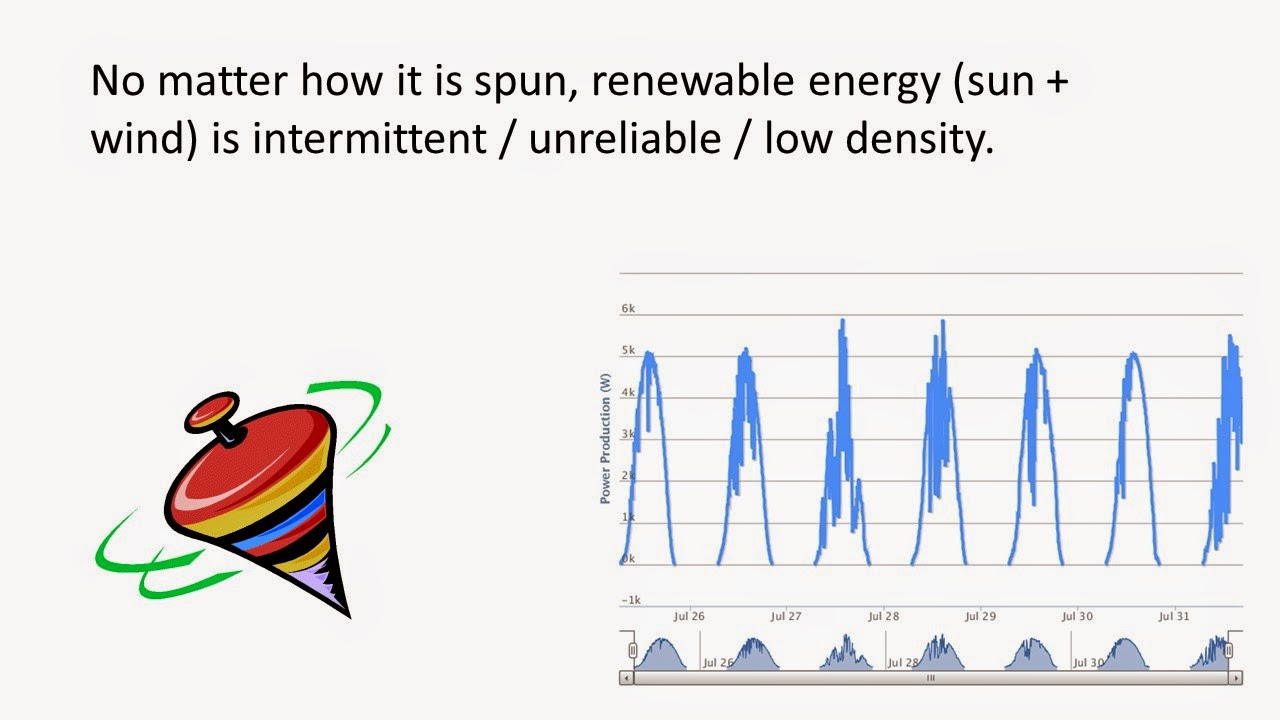
There are many half truths out there that are really complete lies.  For example, we hear that solar photo-voltaic (PV) has already achieved "grid-parity", but obviously these calculations do not take into consideration the extra costs that the grid has to absorb to deal with the intermittent / unreliable nature of solar.

As long as solar PV is a small part of the energy mix, the grid can (grudgingly) accept it.  Conventional power generators adjust their output to compensate for the fluctuating nature of solar.  However if solar were a main component of the grid  (as many environmentalists propose) then the equation changes completely and vast amounts of storage would need to be installed.  On the one hand this storage will be an additional investment and on the other it won't be particularly kind to the environment whether it consists of vast warehouses full of batteries, gigantic hydrolysis plants with their respective hydrogen storage tanks or hydraulic reservoirs.

The issue does not stop here, because now we would have to decide for how long we want to store the solar electricity: for eight hours? For eight days? For eight weeks? Costs rise exponentially with each step. 

So, let's make no mistake: the reason we have not moved yet to a low carbon economy is because the fossil fuel economy is much, much cheaper (sure, without pricing the effects of climate change). It is NOT a philosophical choice but an economic one.

Environmentalists challenge this point but you just have to look around and ask why if renewables are as cheap as they say they are, they need subsidies to survive? And even with subsidies they are a minute portion of the global energy supply.

The bottom line is that our governments CAN grant our wishes to move to a low carbon economy BUT at least in the short term it would translate into much higher energy prices and thus a considerably lower standard of living for most of us. Are we willing and ready now to sacrifice in this manner to prevent a global climatic catastrophe?

This is the most important real question that we need to answer in the energy debate.

It is a fact that we have to move to a low carbon economy, but we need to understand and accept the consequences beforehand.

Labels: , , , ,