Tuesday, September 23, 2014

Key World Energy Statistics 2014

The Key World Energy Statistics 2014 has just been published by the International Energy Agency.
A link to the full report is at the bottom of this page.


Total Primary Energy Supply. Fossil fuels still comprise 81.7% of the total (a slight market participation increase from the 2013 report).

Solar + Wind + Geothermal, etc., have finally exceeded 1% of the total.

Let's now see the top producers per energy source.

Oil:


Coal:


Natural Gas:


Nuclear:
Two countries represent almost 50% of the world's production.
Germany is still a nuclear nation.
China is coming from behind, but may eventually overtake the USA.


Hydro:
Nobody touches China.

And finally, here we present total final consumption:


Fell free to add to the conversation in Twitter: @luisbaram

Link to the full IEA report:

http://www.iea.org/publications/freepublications/publication/key-world-energy-statistics-2014.html

Labels: , , , , , , , , ,

Wednesday, September 03, 2014

Political Will


We hear time and again in the climate discourse that what we need to solve the problem is "political will."

Well, maybe... but combating climate change through reducing our CO2 emissions is not something that can be done by passing a law or signing new regulations.

This is not a Manhattan Project, the Apollo Program or the Great Society of LBJ. It is probably the three of them combined and multiplied by ten, and even then...

We will not be free of fossil fuels by issuing an Emancipation Proclamation. If only it were that simple...

First, let's mention what we don't need respecting the transition to a low carbon economy:

1. To be told it will be easy. Because it won't.
2. To be told it will be cheap. Because it won't.
3. To be told it can be done fast. Because it won't.

Now, the first thing we need to understand is the MAGNITUDE of the energy we should transition from high carbon sources to lower carbon ones. And, by the way, the sooner we bury the "zero emissions" label, the better. No energy source is zero emissions. *


As we may see from the graph above, fossil fuels not only overwhelmingly dominate the energy market, but in absolute terms are the ones that are growing the fastest.**

Even though the OECD countries ARE taming their energy hunger, the non-OECD are increasing it as if they had an appointment. ***


And let's make no mistake: the overwhelming consideration for increasing energy consumption in these Non-OECD countries will be cost and ease of scalability.

The first thing we need to confront the climate challenge is to start telling the truth and this starts with Al Gore, Greenpeace, Paul Krugman and others. Here are some inconvenient truths:

a. Moving to a low carbon economy will be expensive. Very expensive. Thus the cost of energy for the final consumer will be higher, maybe even much higher.
b. If the cost of energy goes up, then the cost of almost everything else will also go up, including food.
c. After many trillions of euros of investment we will end up with less than we began with (lower carbon but more expensive energy). For the final user there would be little to see (except maybe much less pollution from coal burning).

All the people participating in a Climate March should go ahead and do it but be perfectly conscious that if they are FINALLY listened to by governments, THEIR cost of energy and everything else will go up. Is this a sacrifice they are willing to assume? Hopefully yes, but fully understanding what they are actually asking for and how it will affect them individually.

Now we are going to have to call names. It would be great just to leave this at the philosophical level but emissions won't drop just because we wish them to. No, we need MASSIVE deployments of low carbon energy. And here we have to face other truths (valid at least through the rest of this century):

1. Hydro was, is, and will continue to be the premier renewable energy.
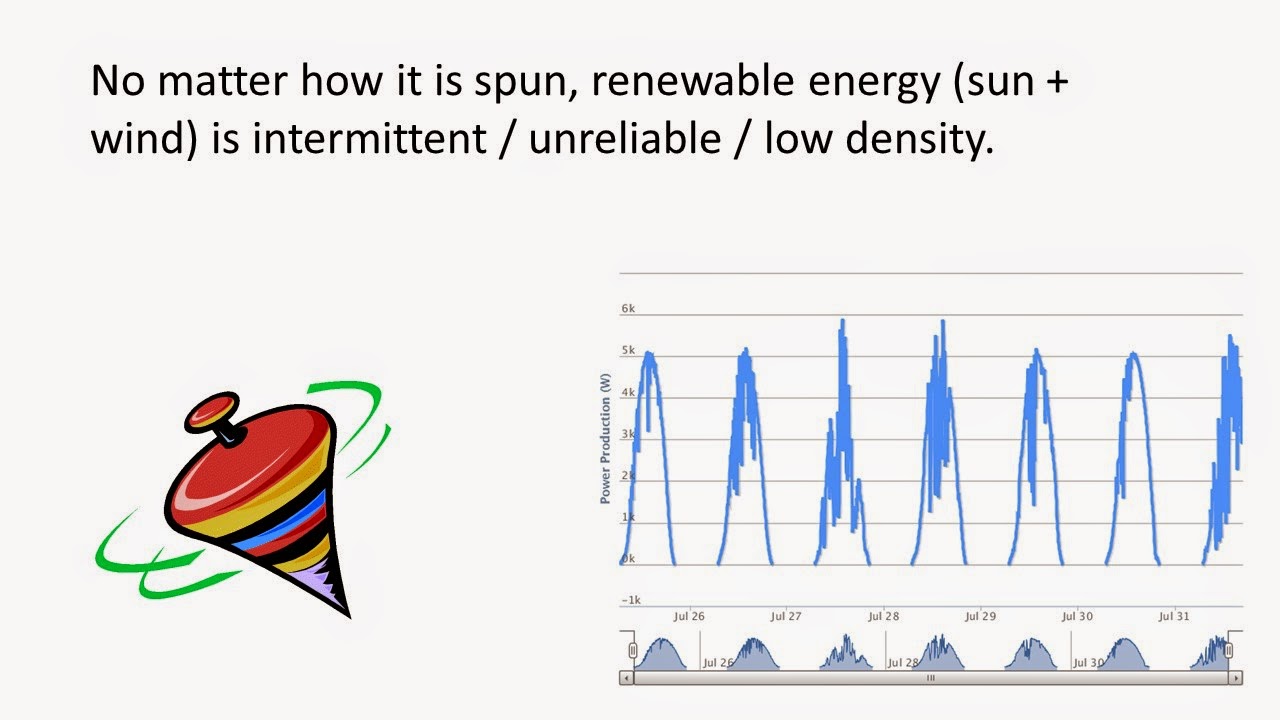
2. Yes, wind and solar will conquer part of the energy pie but will almost certainly stay in single digits share of our global energy consumption. Why? Because they are intermittent, unreliable, diffuse and expensive.
3. (This is to some the worst of all the inconvenient truths), nuclear will have to perform the heavy low carbon lifting for our civilization. Sorry, but there is NO way around this. Make the math, it would be impossible in a financial / environmental sense to supply most of our global energy with renewables.

So, once it is boiled down to the essentials, this is the definition of political will respecting global warming:

Political will: paving the way for a massive, accelerated implementation of nuclear power.

All the rest is just talk, just platitudes, just expressing feel good words that change absolutely nothing.

Look around you! Is a massive nuclear power plant buildup currently happening in your country?

If yes, you are moving forward.

If no, it is business as usual and you are not going anywhere (except maybe to an overly hot planet).

Feel free to add to the conversation at Twitter: @luisbaram

Note: some people declare that renewable energy (solar or wind) is cheap but this is only because they piggy-back on the conventional energy grid (that ends up absorbing the costs of their intermittency). However, when all costs are considered, RE is expensive, intermittent and unreliable.

References:

* http://en.wikipedia.org/wiki/Life-cycle_greenhouse-gas_emissions_of_energy_sources

** bp.com/statisticalreview

*** www.eia.gov/forecasts/ieo/pdf/0484(2013).pdf


Labels: , , , , , , , , , ,

Wednesday, August 13, 2014

Memes in the Energy Discourse

Dear friends, for some months I have been creating memes for the energy discourse. The pictures themselves I got from the Internet.

Feel free to use them, or as we say here: feel free to steal shamelessly.

Thank you.


That is all. Feel free to add to the conversation in Twitter: @luisbaam

Thank you.

Labels: , , , , , , , , ,

Friday, June 06, 2014

Nuclear Energy: Let's Get Real

First let me say off the bat that I consider nuclear power one of the best energy sources we have. Why?

Because nuclear is dense, reliable, constant, low carbon, relatively safe, scalable and proven technology.
It also generates little (although dangerous waste).

Actually, nuclear is so good that if humanity didn't have it, we would need to invent it.

Again, off the bat let me say that I consider that eventually nuclear will supply more than 50% of humanity's energy. By nuclear I mean fission and fusion. In fission we are including uranium and thorium and all sorts of reactor designs. On the other hand, "eventually" doesn't necessarily mean soon.

So, after stating the above, we don't want to sound like Greenpeacers promoting renewable energy and thus here is a dose of reality:

In a previous post,* we calculated that to expand nuclear generation to comprise 50% of global electricity requirements (and say, 25% of global energy requirements) we would need to commission 87 one GWe nuclear reactors every year for 30 years. Or, if you prefer, half that amount of reactors for 60 years.**

Today, only China seems serious about massively increasing their nuclear capacity and currently have 28*** reactors under construction. Comendable, but hardly enough.

Remember, if we want to produce 50% of our electricity with nuclear by 2040 we need to commission 87 reactors in 2014; 87 more in 2015; 87 more in 2016; 87 more in 2017; 87 more in 2018; 87 more in 2019...

Sure, we might say, we are not starting now, but later, still it is inescapable that a dramatic nuclear buildup is required. 

Thus, we have to differentiate what is technically feasible from what is probable.

Is it feasible to produce 50% of the global electricity with nuclear? If France is already producing close to 80% of its annual electricity with nuclear, there shouldn't be any insurmountable technical limitations for the world to "go the way of France." 

However, now we have to ask how probable it is that we will commission 87 reactors (average) per year for 30 years. I would say the probability is extremely low, almost zero.

OK, what about 43 per year for 60 years? Hmmm... that seems more probable.

And what about 29 for 90 years? This looks awfully more probable.

The EIA estimates that by 2040 nuclear energy will supply 14.1% of global electricity (and say, half of that for total energy usage).

For the other low carbon energies, the EIA estimates the following penetrations in global electricity generation:****

Hydro: 16%.
Wind: 4.7%
Solar: 1.2%

Adding all of the above (including nuclear) we reach a total of 36%. Thus the rest, 64% would still be comprised of combustible fuels by 2040.

And let's remember this is only electricity generation. The rest of our energy requirements would be even more heavily represented by fossil fuels.

Thus and if you ask me, the responsible thing to do is to plan for a world where fossil fuels continue to dominate the energy market for the rest of this century.

Conclusion: nuclear energy will eventually supply more than 50% of humanity's energy. "Eventually" means 100 to 150 years in the future. From now until then, fossil fuels will continue to provide the heavy lifting for our civilization.

Feel free to add to the conversation on Twitter: @luisbaram


* http://gnwr1.blogspot.mx/2014/04/going-nuclear.html

** Considering energy requirements won't continue to increase after 2040.

*** http://www.world-nuclear-news.org/NN-Start-up-nearing-for-Chinese-units-2503144.html

**** http://gnwr1.blogspot.mx/2013/08/international-energy-outlook-2013.html

Labels: , , , , , ,

Tuesday, March 18, 2014

A Tale of Two Countries

In the energy discourse we hear a lot about renewable energy, zero emissions, Energiewende, installed capacity, etc. However, today we are trying to clear the air a little bit by publishing the results. Yes, here we are removing the hype and the wishful thinking and presenting just the results.
Luckily, we do have two countries that pursued different paths toward a low carbon electric generation system.
The first is Germany that committed to eliminating nuclear and producing most of its electric power with renewables (sun and wind), the other is France that decades ago decided to go mainly nuclear.

Here we can see the latest report from the IEA (International Energy Agency) in which we can see the actual energy generated during 2013 by each type of fuel. First we have Germany:

As we may see, combustible fuels continue to lead in German electricity production. Nuclear is still in second place. Sun + wind, on the other hand, barely increased their actual output in spite of the fact that their installed capacity continued to increase.

Now, let's take a look at France:

Think what we may about nuclear, it is a low carbon electricity producer. So France overwhelmingly produces its electricity via low carbon means and it shows.

If we now take a look at the ultimate climate result, we may see that German electricity is more than six times more carbon intensive than the French one.


This Tale of Two Countries is trying to point out which approach is actually working in the real world.

Thank you.


Labels: , , , , , ,

Sunday, July 28, 2013

Beating a Dead Horse

A substantial, if not most, of what we hear today about global climatic disruption concerns people trying to prove that it is actually occurring.
Well... we do not have to continue beating a dead horse. Climatic change caused by our civilization's excessive carbon dioxide emissions is a fact. Period. Let's move on.

Almost immediately after stating the obvious, two other things come into the picture of the environmentalists:
a) The "climate change deniers" (a label always mentioned with scorn).
b) The lack of political will from governments.

Climate change deniers are not dumb, they are only suspicious of what they may be committing to if they accept that anthropomorphic emissions are driving harmful change. Consciously or at the gut level, they know that combating climate change would entail less personal choices and a significant reduction in their standard of living.

Now, with respect to "lack of political will", governments cannot get too far ahead of their constituents. If they do, they seriously risk being removed from office at the drop of a hat. 

The fact is that moving to a low carbon economy would entail, in the short and medium term, very significant increases in the prices of energy and transportation that would cascade through the economy and create serious inflation, job losses and a general reduction of our standard of living (exactly what the climate deniers fear). 

In theory, governments could act very fast with measures that would significantly reduce carbon emissions in the short term, for example by applying heavy carbon taxes.  However, most of the population on Earth is not ready, or willing to accept these drastic measures. 

Some environmentalists keep preaching that the transition to a low carbon economy (through "renewable energy") can be fast and painless. They are performing a disservice to humanity because what they are saying is plain false. Solar PV and wind heavily depend on subsidies and the moment they are removed (e.g. see what is happening in Spain) they come tumbling down. Besides, their intermittency produces hidden costs that are masked by the conventional power grid but, if their penetration continues to increase these costs will be impossible to hide any longer. If the conventional grid is decommissioned, then vast and expensive storage would be required (storage that, by the way, wouldn't be too environmentally friendly). From a purely financial point of view it makes no sense because we will need to:
1. Duplicate the current fossil fuel installed capacity (including all the transportation equipment).
2. Replace it with "renewable" capacity.
3. Build the "renewable" storage capacity.

The reason today most of the energy of civilization comes from fossil fuels is not because of a perverse twist in human psyches; rather it is because they are, by far, the cheapest type of energy we have access to (at least as we now cost them which is to say WITHOUT considering the cost of extrenalities). Yes, hydro competes with fossil fuels but currently supplies less than 3% of our total primary energy supply and cannot easily be scaled much above that market penetration. 

Bottom line: we all have to begin telling the truth about the consequences of a low carbon economy. That means asking the population to volunteer for serious sacrifices and significant changes in how we live. 

In the short term, a low carbon economy would seem much worse than mitigating climate change effects, in the long run, it might be the only alternative we have. 


Labels: , , ,

Monday, July 08, 2013

Going Green

More and more we hear people getting impatient with their governments and demanding them to implement the right policies to "go green."

Is this possible?

If by "going green" we mean moving to a less carbon intensive economy then the answer is that technically it is completely feasible.

So then, what is the catch?  The catch is that a low carbon economy today would be more (actually much more) expensive than the current one.

This is something we all have to understand when we demand our governments to act. Actually our demands should be preceded by deciding how much each one of us is personally willing to sacrifice in the form of higher (much higher) energy prices. 

How much are we willing to pay for the liter (or gallon) of gasoline, for the kWh, for our airplane tickets and even for everything else? In a low carbon economy almost everything, including food, would be more expensive.

There are many half truths out there that are really complete lies.  For example, we hear that solar photo-voltaic (PV) has already achieved "grid-parity", but obviously these calculations do not take into consideration the extra costs that the grid has to absorb to deal with the intermittent / unreliable nature of solar.

As long as solar PV is a small part of the energy mix, the grid can (grudgingly) accept it.  Conventional power generators adjust their output to compensate for the fluctuating nature of solar.  However if solar were a main component of the grid  (as many environmentalists propose) then the equation changes completely and vast amounts of storage would need to be installed.  On the one hand this storage will be an additional investment and on the other it won't be particularly kind to the environment whether it consists of vast warehouses full of batteries, gigantic hydrolysis plants with their respective hydrogen storage tanks or hydraulic reservoirs.

The issue does not stop here, because now we would have to decide for how long we want to store the solar electricity: for eight hours? For eight days? For eight weeks? Costs rise exponentially with each step. 

So, let's make no mistake: the reason we have not moved yet to a low carbon economy is because the fossil fuel economy is much, much cheaper (sure, without pricing the effects of climate change). It is NOT a philosophical choice but an economic one.

Environmentalists challenge this point but you just have to look around and ask why if renewables are as cheap as they say they are, they need subsidies to survive? And even with subsidies they are a minute portion of the global energy supply.

The bottom line is that our governments CAN grant our wishes to move to a low carbon economy BUT at least in the short term it would translate into much higher energy prices and thus a considerably lower standard of living for most of us. Are we willing and ready now to sacrifice in this manner to prevent a global climatic catastrophe?

This is the most important real question that we need to answer in the energy debate.

It is a fact that we have to move to a low carbon economy, but we need to understand and accept the consequences beforehand.

Labels: , , , ,